
Ad intelligence software has become essential due to the emerging trend of digital ads to grow businesses and, most importantly, to compete with rivals.
As advertising investment continues to accelerate in 2026. The IAB now forecasts U.S. ad spend to grow 12.3% year over year, with social media (+16.5%), connected TV (+15.6%), and commerce media (+13.6%) leading the expansion, and these platforms can give you a huge amount of raw data to help you make decisions on paid marketing for your brand.
However, it is true that more data does not automatically create better campaign decisions because if you don’t know how to read that data, then you still miss the real pattern.
According to my observation, the best ad intelligence tools do more than show you just competitor ads.
I mean, they help you detect trends, compare creative and messaging strategies, track changes over time, and turn observations into practical campaign hypotheses.
And with the right tool, marketers can move beyond guesswork and make more informed paid-marketing decisions very easily.
Because there is a clue in every winning ad creative or message, and ad intelligence software helps you to collect those clues, spot patterns, and turn competitor activity into better campaign decisions.
What You Get From This Post
In this guide, you’ll see a comparison of 5 ad intelligence software tools based on what they do best because not every platform is made for everyone. I have selected each tool based on your marketing goals, budget, and preferred advertising channels. I’ve written this for digital marketers, media buyers, ecommerce brands, affiliate marketers, and agencies who want to make smarter paid-campaign decisions.
Table of Contents
TL;DR: Best Ad Intelligence Software by Use Case
These are the 5 best ad intelligence platforms I listed here to give you a clear picture. However, these platforms don’t reveal a competitor’s exact ROAS or complete targeting strategy.
- Best for finding winning Meta/TikTok ad networks: SpyTrend
- Best for full marketing funnel tracking: Panoramata
- Best for Google Ads and SEO competitor research: SpyFu
- Best for finding general ad ideas: BigSpy
- Best for dropshipping: Minea
So, if you focus on Meta and TikTok performance campaigns, look closely at Spytrend.
If you’re tracking a competitor’s complete marketing funnel, including emails, landing pages, and promotions, choose Panoramata.
For Google Ads and SEO, choose SpyFu.
If you are new to ad research, start with BigSpy for broad creative discovery.
If you sell physical products, Minea is built around ecommerce and dropshipping research.
What Is Ad Intelligence Software?
An ad intelligence software helps marketers monitor public competitor advertising activity (complete funnel) and shows you the data so that you can make better paid marketing decisions over time.
These online ad intelligence tools are not like any UGC ad generators that we use to create UGC ads. But, I would say these tools are a kind of ad database tool with filters to remove unnecessary ads on the market and spot the patterns of campaigns that are feeding your competitor’s brand.
However, there is one important limitation here because no ad intelligence tool can reveal your competitor’s actual ROAS, conversion rate, complete targeting strategy, or true campaign profitability.
So, the public ad data these platforms show is just research evidence.
Comparison Table: 5 Best Ad Intelligence Software Tools
Here is a quick comparison table for the 5 best digital ad intelligence software tools for you
Tools & Ratings | Best For | Key strength | Main limitation |
Meta and TikTok competitor-network research | 1.4B+ ad archive; webmaster-level grouping | It can’t show you conversion data | |
Tracking the full competitor funnel | Reveal competitor’s entire digital marketing strategy | A bit pricy as it covers the whole areas | |
SpyFu | Doing research on competitor’s Google Ads and SEO strategy | Competitor keywords and PPC research | Sometimes you experience the data inaccuracy |
BigSpy | Free ad research and creative inspiration | Large ad database and filters | No advertiser-network mapping or no full-funnel marketing tracking |
Minea | Ecommerce and dropshipping research | Product, store, and ad discovery | It’s heavily product focushed |
5 Best Ad Intelligence Software for Smart Campaigns
Here are the 5 best ad intelligence software platforms to analyse your business competitors
- Spytrend: Best for Meta and TikTok competitor network research
- Panoramata: Best for brand and creative benchmarking
- SpyFu: Best for Google Ads and SEO competitor research
- BigSpy: Best free Ad intelligence software to start with
- Minea: Best for ecommerce and dropshipping ad research
1. Spytrend: Best for Meta and TikTok Competitor Network Research
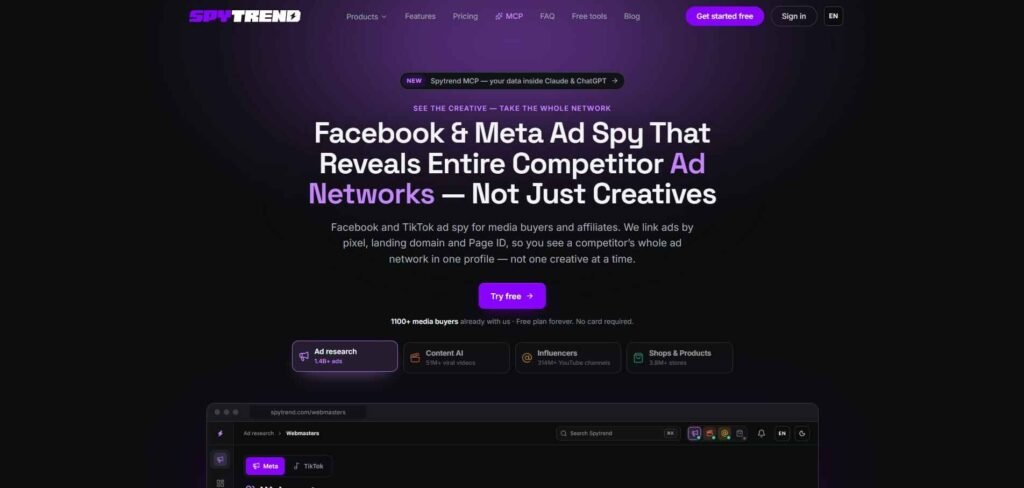
Spytrend is an advanced ad intelligence software built for media buyers, affiliates, agencies, and ecommerce marketers researching Meta and TikTok campaigns.
It helps you connect ads through pixels, landing domains, Page IDs, and IP addresses, and this is where I prefer this tool most because it makes it easier to see your competitor’s broader advertising network, repeated offers, landing pages, and active campaigns.
Best For
Spytrend is best for a media buyer who wants to map competitor activity quickly, an affiliate marketer searching for repeated offers, or an ecommerce team studying product ads and landing pages across Meta and TikTok.
Spytrend Review: When You Should Select SpyTrend
Try to choose Spytrend when you want to research competitors mainly on Facebook or TikTok and want to study a competitor’s complete ad network instead of one creative.
What I found is that Spytrend’s biggest advantage is its broad-level view with many filters so that you can search by a competitor’s website, pixel ID, domain, or Page ID and find related ads instead of manually collecting isolated screenshots.
Spytrend Review: When You Should Avoid SpyTrend
The main limitation is coverage of this tool because Spytrend focuses on Meta and TikTok, so it will not replace tools designed for Google Ads, display advertising, mobile intelligence, or broader market research.
You can also watch my video, where I showed you the way to use Spytrend for creative ad research on Meta & TikTok.
Spytrend Pricing
Spytrend offers a limited free plan with no credit card requirement. Paid access starts at $79 per month.
However, during my testing, I noticed that it charged tokens while finding a cloaked funnel (sometimes a product needs different landing pages in different countries).
2. Panoramata: Best for Brand and Creative Benchmarking
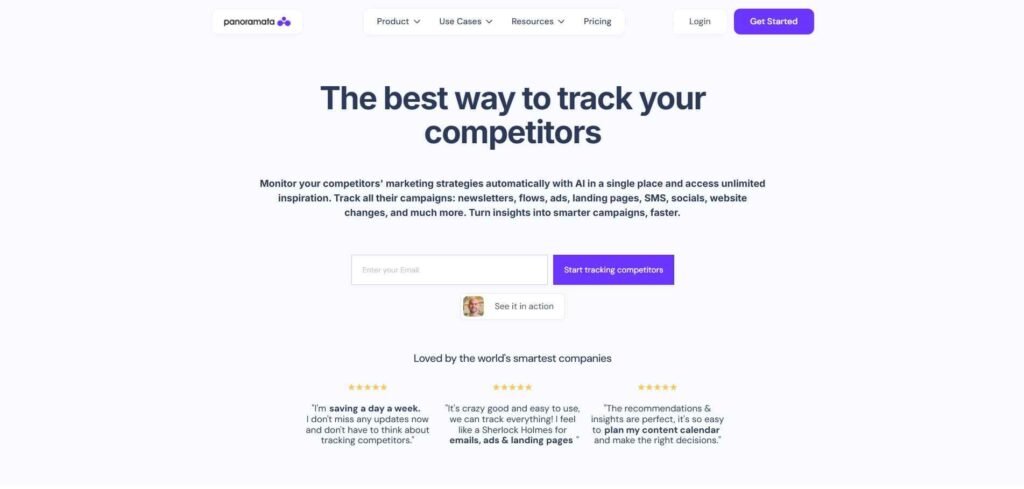
Panoramata is a competitive marketing intelligence platform that tracks or monitors your competitors’ newsletters, emails, paid ads, landing pages, SMS campaigns, social activity, website changes, promotions, and marketing flows in one workspace.
In one sentence, we can say that it helps you to reveal your competitor’s entire digital marketing strategy in one research workspace.
Best For
Panoramata is best for ecommerce brands, agencies, and marketing teams.
When You Should Select Panoramata
Choose Panoramata when you need to benchmark competitor brands across several marketing channels by studying their ads, emails, landing pages, offers, and promotions as one connected strategy.
Panoramata is a step ahead of Spytrend in terms of broad coverage, as Panoramata not only tracks Meta or TikTok ads but also covers Google Display, YouTube, Pinterest, and LinkedIn ads as well.
When You Should Avoid Panoramata
Panoramata may not be the best choice if you want something specific, like you only need Meta or TikTok ads, or you want a low-cost tool for occasional creative inspiration, because it is a broad monitoring system, and it may feel excessive for you if you need to research only one channel.
Panoramata Pricing
Panoramata’s pricing plan starts at $99/month for up to 20 competitors and six months of history. It is a bit more expensive than Spytrend.
3. SpyFu: Best for Google Ads and SEO competitor research
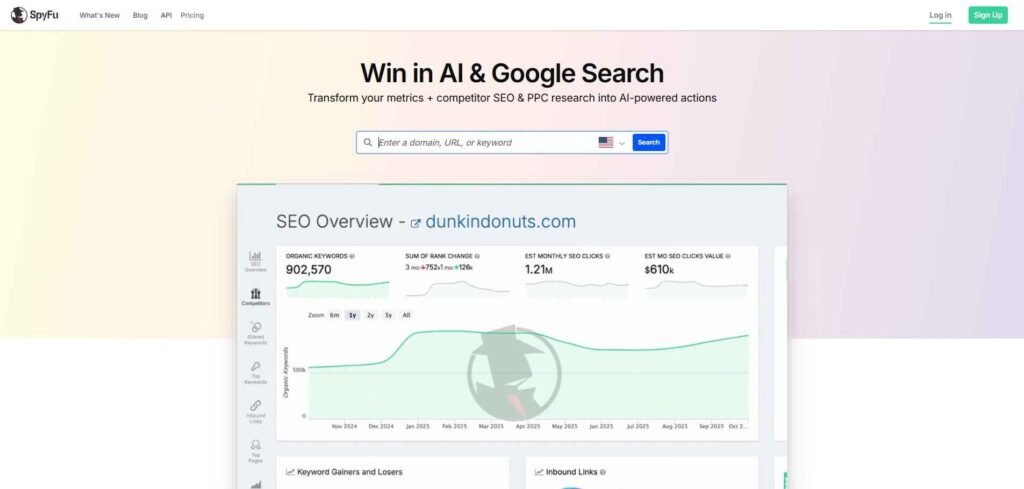
SpyFu is a paid-search intelligence and SEO platform that helps you study your competitor keywords, Google Ads, ad copy, landing pages, rankings, backlinks, and estimated ad budgets. It is especially useful when your campaign decisions depend on search intent rather than social creative trends.
In one sentence, in SpyFu, you can enter your competitor’s domain and see the keywords it buys on Google, estimated clicks and costs, ad-test history, and the keywords it ranks for organically.
Best For
SpyFu is best for PPC specialists, SEO teams, and content marketers who want an affordable option.
When You Should Select SpyFu
Choose SpyFu when you want a tool that covers PPC as well as SEO (Search Engine Optimisation) as well.
Its strength is Google search intelligence, so it is not a direct replacement for tools we have discussed earlier such as BigSpy, Spytrend, or Panoramata
When You Should Avoid This
SpyFu may not be the right choice if you need Facebook, Instagram, TikTok, or YouTube creative research or want to track competitor emails, SMS, landing pages, and marketing flows.
SpyFu Pricing
SpyFu’s membership starts at $33/month, with unlimited data and downloads. The company also offers a 30-day money-back guarantee and no contracts.
4. BigSpy: Best Free Ad Intelligence Software to Start With
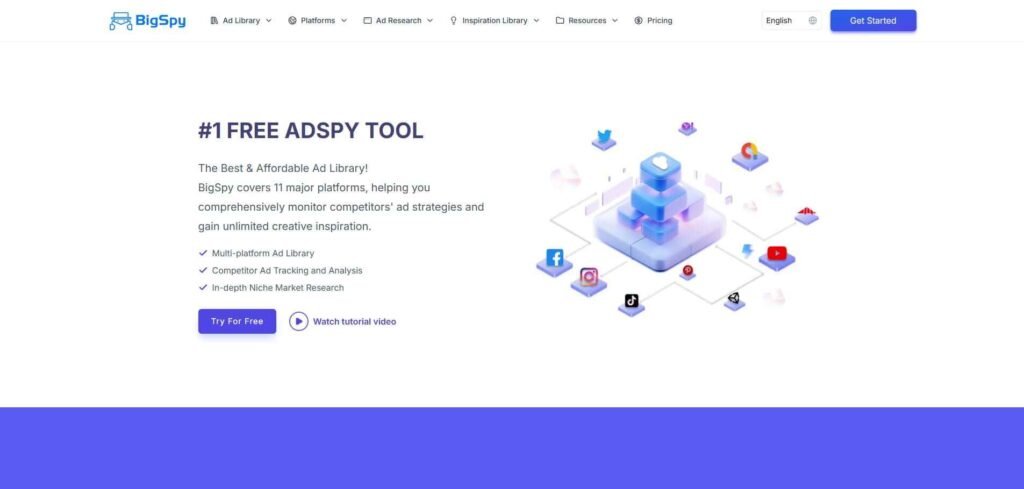
BigSpy is a useful starting point if you want to explore competitor ads without immediately paying for an expensive digital ad intelligence platform. It offers a free plan for Facebook creative research and paid plans that expand coverage to Instagram, Google Ads, YouTube, TikTok, X, Pinterest, Yahoo, Unity, Pangle, and AppLovin
This is why BigSpy is suitable for marketers who want to confirm whether ad research tools are useful before committing to a subscription.
Best For
BigSpy is best for beginner marketers, affiliate marketers, small ecommerce teams, and content strategists who need a low-risk way to study competitor creatives and identify possible campaign angles.
When You Should Select BigSpy
BigSpy positions itself as a large ad-spy database rather than a full marketing-intelligence suite like the other two tools we just discussed.
So, go with this tool if you’re a beginner and want to start ad research without an immediate paid subscription.
When You Should Avoid BigSpy
BigSpy may not be ideal if you need a full-funnel tracking system like Spytrend and Panoramata have.
So, if you’re just starting, then definitely start with BigSpy, but if you’re an expert, then go with others.
BigSpy Pricing
BigSpy has a permanent Free Plan with 10 searches per day, three AI prompt conversions per day, and tracking for up to 20 creatives. Paid plans start at $49/month when billed annually.
5. Minea: Best for Ecommerce and Dropshipping Ad Research
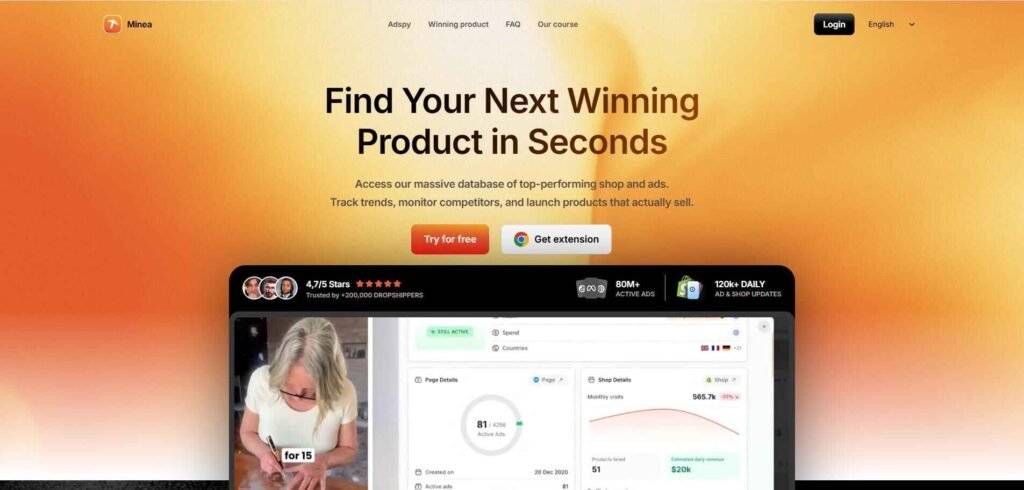
Minea is an ad intelligence and product research platform designed for ecommerce sellers, dropshippers, and product researchers who want to find trending products and study the ads behind them.
I would say that Minea is more product-led than the ad intelligence platforms we just discussed earlier in this list.
Best For
Minea is best for ecommerce sellers, dropshippers, and product researchers to find trending products.
When You Should Choose Minea
Choose Minea when your main objective is to sell physical products through Shopify, WooCommerce, or another ecommerce platform and you need winning or trending products before launching a store.
When You Should Avoid Minea
Minea may not be the best choice if you want to analyse a full marketing funnel or do SEO keyword research for organic growth.
Its value is strongest in ecommerce and dropshipping product research, so it is not a direct substitute for Spytrend, Spyfu or Panoramata.
Minea Pricing
Minea’s paid plan starts at $49/month. A quarterly and yearly plan is also available at a lower price.
How to Turn Competitor Ad Data Into Better Campaign Decisions
Running a better campaign is extremely useful to driving revenue for your brand. But this is only possible if you have a clear mindset about what you’re going to do next.
To me, analysing the data is one thing, and how you use that data to execute your campaign in the real world is another thing. However, both of these need extreme care and attention.
Here are 5 areas that I want to highlight to run a better campaign.
Always Find Patterns, Not Isolated Ads
I know this is basic, but this is one of the most important areas that you should focus on first.
To do this job, pick a paper, or you can go with a Google or Notion doc and create a column of ‘common findings’ across multiple creatives (problems, offers, discount, angle, format, landing page decoding).
You know that during my content marketing career, the main driver of my growth came not from learning first but from watching what winners have in common.
Trust me, this is a skill and over time, you’ll get better at this and in this case, the above ad analysis tools will help you a lot before your PPC ad campaign.
Track Changes in Offers, Hooks, and Landing Pages
This is the second one and a rabbit hole version of the first point we just discussed. I would say this process is a data-building phase where you’re not just noting down the winning ad specifications, but you’re also watching the changes.
After you notice a change, then your job is to validate this change by asking “Why?” Like, why did they change?
Please do not make decisions based only on your competitors’ changes. Use your marketing expertise to check every possible way.
Turn One Competitor Observation Into a Test Hypothesis
Try to turn every useful competitor observation into a clear campaign question.
Like, if you notice that several competitors use customer pain in their video hooks, test whether a problem-focused opening generates more qualified clicks than your current product-focused message.
In another way, if your competitors promote free trials instead of discounts, test whether testing this improves sign-ups.
A strong hypothesis connects your observation, the expected customer behaviour, and the variable you will change, such as the hook, offer, CTA, creative format, or landing-page headline.
Connect Competitor Data With Your CRM and Campaign Results
Competitor data is more useful when you compare it with your own customer and campaign data.
For example, if a competitor is promoting a feature to e-commerce founders, check whether that audience is active in your CRM. Also check whether similar messages have already improved your clicks, leads, or sales.
This helps you decide whether the competitor’s message is relevant to your audience or only popular in the wider market.
Connect competitor insights with your CRM segments, campaign results, conversions, and customer feedback. Then use both external competitor signals and your own business data to plan your next campaign test.
Keep Human Review for Brand and Creative Decisions
This is non-negotiable, and you have to commit your time and energy to get maximum benefit.
I would say that you should or must use ad intelligence software to organise research and identify patterns, but always keep human judgment in the final decision.
You already know that automated tools can misread cultural context, emotional messaging, or the reason an ad is still running.
So, before using an insight, check whether it fits your brand guidelines, customer language, positioning, and legal requirements.
In simple terms, these marketing tools can speed up your research, but you or your team still decides what deserves to be tested.
Final Verdict: Which Ad Intelligence Software Is Best?
As I told you at the very beginning of this listicals that, there is no single best ad intelligence software for every marketer. However, the right choice depends on the channel you need to monitor and the decision you want the data to support.
Here is a straightforward solution
- Choose Spytrend for Meta and TikTok competitor-network research.
- Choose Panoramata for brand, email, landing-page, and creative benchmarking.
- Choose SpyFu for Google Ads keywords, ad history, SEO, and paid-search research.
- Choose BigSpy if you want a free starting point for ad research.
- Choose Minea for ecommerce products, stores, and dropshipping research.
Go with one of the above Ad intelligence solutions and try to figure out the pattern to capture the real trend of winning ads.
Thank you…
Smile.