There was a time when running ads as a small business owner felt like a difficult task. Plus, you don’t have the bigger budgets to make that happen, fully functional.
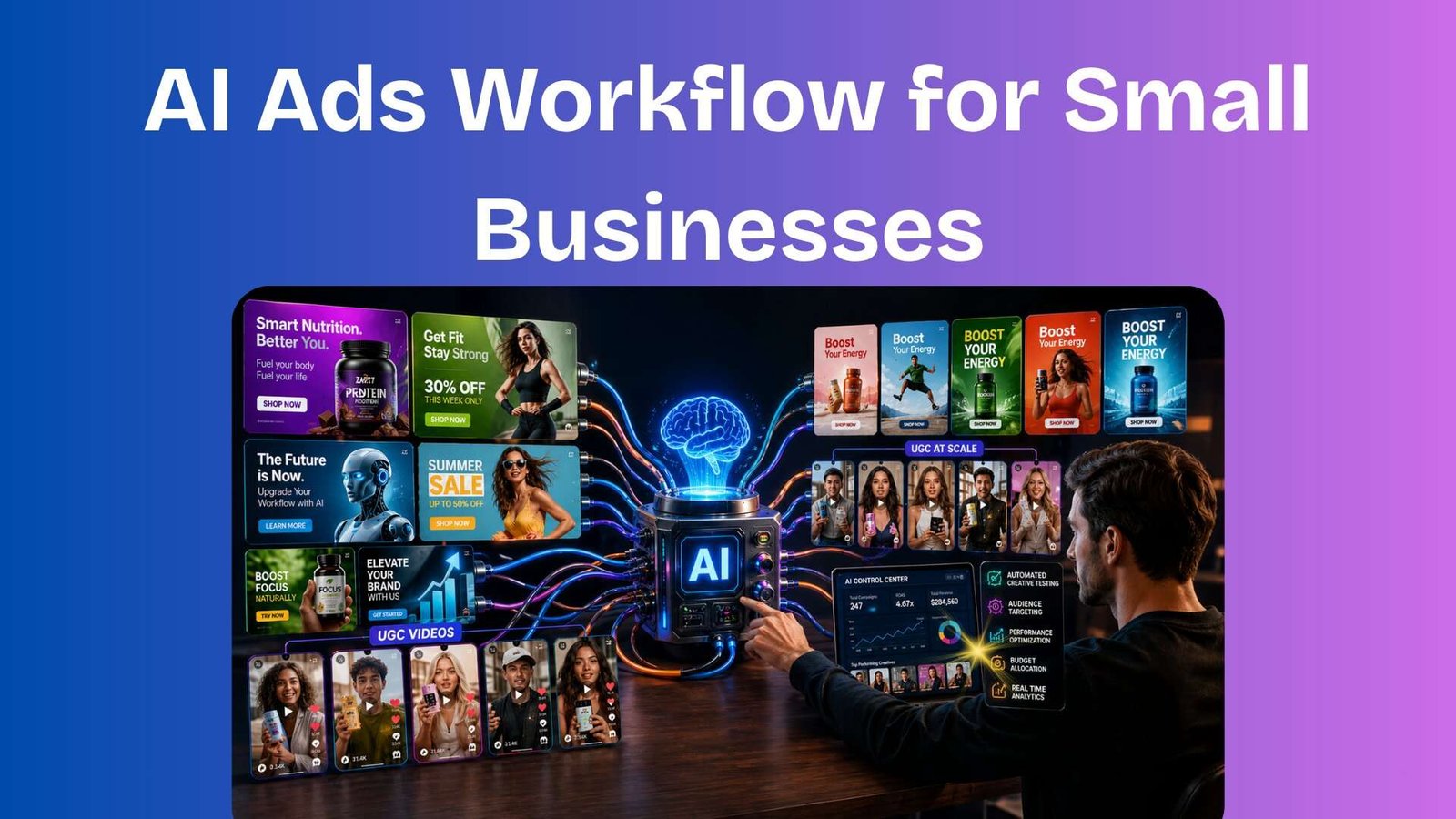
But as of 2026, AI changes that equation completely for you, only if you know the right AI ads workflow, or the proper way for small businesses to use AI in marketing.
I genuinely believe AI is the greatest tool small businesses have ever had access to. It doesn’t care about your budget. It doesn’t need a full marketing department to function.
In my experience working with small business owners, the ones who struggle with ads aren’t failing because of money, but they’re failing because there’s no repeatable system behind their campaigns. They’re guessing. Every. Single. Time.
That’s exactly where a solid AI ads workflow for a small business becomes your unfair advantage. It gives you agency-level execution at a fraction of the cost, even if your entire “team” is just you and a strong cup of coffee.
Table of Contents
Understanding the Framework: What are the 4 Stages of an AI Workflow?
Most small business owners jump straight to “boost post” and hope for the best. I’ve seen it drain their budgets fast, and it’s completely avoidable.
To be honest, a structured AI ads workflow framework isn’t just for big companies. It’s actually more powerful if you have a small team.
Think of it as four gears of your car working together:
Stage 1 — Research & Strategy:
AI will help you identify your audience to remove the guesswork before you spend a dollar. But, here is a catch…
Look at the example…
Example:- For research and strategy development, go to the social platforms, like Amazon reviews, Quora, Reddit and others like that, to find out what your customers are saying about the same category products that you’re trying to sell. Then try to note down their needs, desires, complaints, firm beliefs, etc.
Remember that “FREQUENCY IS VERY IMPORTANT”, like how many times you find the repetition of each emotion from your customers. Mark those phrases or words. This will help you to prioritise which to highlight in your ad and which not.
Stage 2 — Content Generation:
Now, after you’ve collected the raw data, it’s time to produce copy, visuals, and ad variations with the help of your AI advertising makers.
But how? Look at the example.
Example:- Dump that raw unfiltered data into free tools like ChatGPT or Gemini and run a prompt like this:
“Use this data and tell me what my would-be customers are thinking about that product. Point out their needs, desires, complaints, and firm beliefs with high frequency to low”
So……… After generating this, you have to create content pieces for your Ads.
Now….. Simply run this FREE MASTER PROMPT.
This prompt will instantly create a high-converting ad script or ad copy for you.
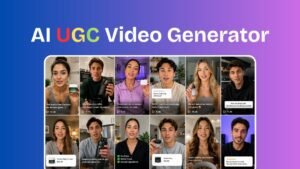
Now use the script or the ad copy to generate the viral UGC ad videos or static ads, whatever you want.
Stage 3 — Distribution & Launch:
Now deploy those high-conversion focused smart ads across Google, Meta, TikTok and YouTube with precision targeting.
Example:- Let’s say your audience resides on Instagram, so choose Instagram as a primary distribution channel and then run your AI UGC ads there. Always look for the place where the majority of your audience hangs out.
Stage 4 — Optimisation:
This is where your business transformation will happen because the world of marketing is vast and people’s behaviour changes rapidly.
So, your duty is to apply a system to your business primarily, and then closely monitor the performance data and prepare the next plan for your next move. This is how you can grow consistently.
Example:- Analyse the data from the ads you run and then optimise them according to the results. Just like this:- Apply → Review → Improve → Again Apply.
Creating Your AI Ads Workflow for Social Media & Search
Social media has become the backbone of AI marketing in 2026. However, each platform speaks a different language, and I’ve seen small businesses burn budget by running the same ad everywhere. That’s the mistake we’re fixing here.
In my opinion, always match your AI ads workflow to the platform’s strengths, not your comfort zone.
AI ads workflow for Instagram & TikTok:
TikTok’s 2026 algorithm specifically rewards content that generates “active appreciation”. Signals such as shares, saves, and comments matter the most over passive views.
The most effective AI workflow for these platforms involves generating dozens of “hook” variations at the front end of a campaign.
Instead of producing one “perfect” video, marketers use AI UGC generators to produce 50 variants, each testing a different hook, value proposition, or visual trigger. Superscale shows engagement data for 2026.
AI ads workflow for Google Ads:
Google Ads in 2026 isn’t about keywords anymore; it’s about predicting the exact moment someone is ready to buy. I’ve seen this shift completely change how small businesses compete in search.
AI ads workflow for YouTube:
Feed AI your key message, and it writes the script and assembles the UGC ads prompt. No production crew needed, and now you can compete with big-production brands on a small-business budget.
The success of YouTube ads in 2026 is governed by the ABCD framework, such as Attract, Brand, Connect, and Direct.
Ads that follow Google’s creative best practices are more likely to achieve a 30% lift in short-term sales likelihood and a 17% lift in long-term brand contribution.
Best Free AI Tools for Small Business Ads
Budget is always the conversation with small business owners because here every dollar has to work harder than the last.
To automate with the AI workflow, you don’t need expensive software to run. If you use the right FREE AI tools consistently, they will outperform high-priced software every single time.
Here’s exactly how you can use the free AI tools for your small business ads:
- Copywriting: – ChatGPT or Gemini: Write punchy ad copy, headlines, and CTAs in minutes. Tell it to your audience, your offer, your platform, and it delivers. Always use the effective FREE RESOURCES to generate the AD copy for your brand.
- Visuals: – Canva Magic Studio: Generate on-brand AI-powered advertising assets without touching Photoshop or hiring a designer. If you have a bit of budget, go with these 3 Best AI tools for Ad creatives, small business owners are switching to right now.
- Organisation: – Notion: Managing an AI ads workflow for small teams gets messy fast. This tool keeps your campaigns, deadlines, and creatives in one clean place.
Common Pitfalls Small Businesses Hit With AI Ad Workflows
Before doing anything, just remember that AI won’t save a broken strategy; it’ll just execute it faster.
Here’s what to avoid before it costs you:
- Pitfall 1 — Vague offer, vague results: AI only amplifies what you give it. Garbage in, garbage out. So, define your offer clearly before touching any tool.
- Pitfall 2 — Killing ads too early: Give the algorithm 7–14 days to learn. Optimising on day two is like running a small bakery in Texas and turning off the oven after 1 minute because the bread hasn’t risen yet.
- Pitfall 3 — Creatives that look AI-generated: Audiences notice whether you use AI-generated creatives or human-generated ones. This breaks trust. So, always add a human edit pass before publishing.
- Pitfall 4 — Skipping the “Define” stage: Jumping straight to tools without knowing your audience is the most expensive shortcut in the AI ads workflow for small businesses. The businesses that win are the ones that show up structured.
What You Can (and Can’t) Trust AI to Do
Many business owners make the mistake of giving too much work to AI too soon, and because of that, they lose time and money.
It is very important to understand how AI works. If you use it the right way, it helps your business. If you use it the wrong way, it can cause problems. It’s like a sharp knife. It can help you, but it can also hurt you if you are not careful.
Here’s the honest split every small business owner needs to understand:
- Trust AI with: Copy variations, image generation, bid optimisation, and performance reports, like the repetitive execution work it was built for.
- Never outsource to AI: Never outsource your brand voice, your offer clarity, and your audience insight to AI. Think of AI like a brilliant intern. Fast, tireless, capable, but only as good as the direction you give it.
AI executes, and you strategise. That’s the real partnership.
Which AI tools are best for small business ads for free?
Start with ChatGPT or Gemini for ad copy, Canva Studio for visuals, and Notion for workflow organisation. These three free tools cover the full production cycle of your AI ads workflow without spending a dollar upfront.
How can small businesses use AI to improve digital marketing?
By replacing guesswork with a structured system. AI helps small businesses identify audiences faster, generate high-converting creatives at volume, automate bidding on Google and Meta, and continuously optimise based on real performance data, all without a full marketing team.
Which platform works best for AI ads — Google, Instagram, TikTok, or YouTube?
It depends on your goal. TikTok and Instagram work best for demand creation and creative testing — Google Ads dominates high-intent purchase moments. YouTube is ideal for story-driven, script-based AI video ads. Match the platform to your audience, not your comfort zone.
How long should I run AI ads before optimising?
Give your campaigns a minimum of 7–14 days before making changes. The algorithm needs this learning window to identify patterns and optimise delivery. Cutting ads too early is one of the most common and costly mistakes small businesses make.
Can AI completely replace a marketing team for small businesses?
No — and it shouldn’t. AI executes brilliantly, but it needs human direction. Your brand voice, offer clarity, and audience insight must come from you. The strategy is always yours.